Short answer: the right London creative agency is the one with relevant work in your sector, a named human who actually does the work, pricing you can see, and a genuine reason to be faster than everyone else. For most founders that means skipping both the 30-person network agency and the cheapest freelancer, and choosing a small studio that pairs senior craft with AI. Below is how to tell the difference before you sign anything.
The 60-second version
- Decide what you’re buying first: freelancer, studio, full agency, or AI-first studio. The wrong category dooms the hire.
- Judge the shortlist on five things: relevant proof, a named maker, a real speed advantage, visible pricing, and the quality of the questions they ask you.
- Watch for the classic red flags: senior pitch with junior delivery, “contact us” pricing, and AI claimed but never shown.
- An AI-first studio usually beats a big agency on value for founders and lean teams. A full agency earns its cost only when you have many stakeholders.
I run THETOGLAB, a design and marketing studio in London, so read this as a partial witness telling you how the sausage is made. I’d rather you hire well, even if it isn’t us, than watch you get burned by a logo mill or pay agency overheads for studio-sized work.
First, decide what you’re actually buying
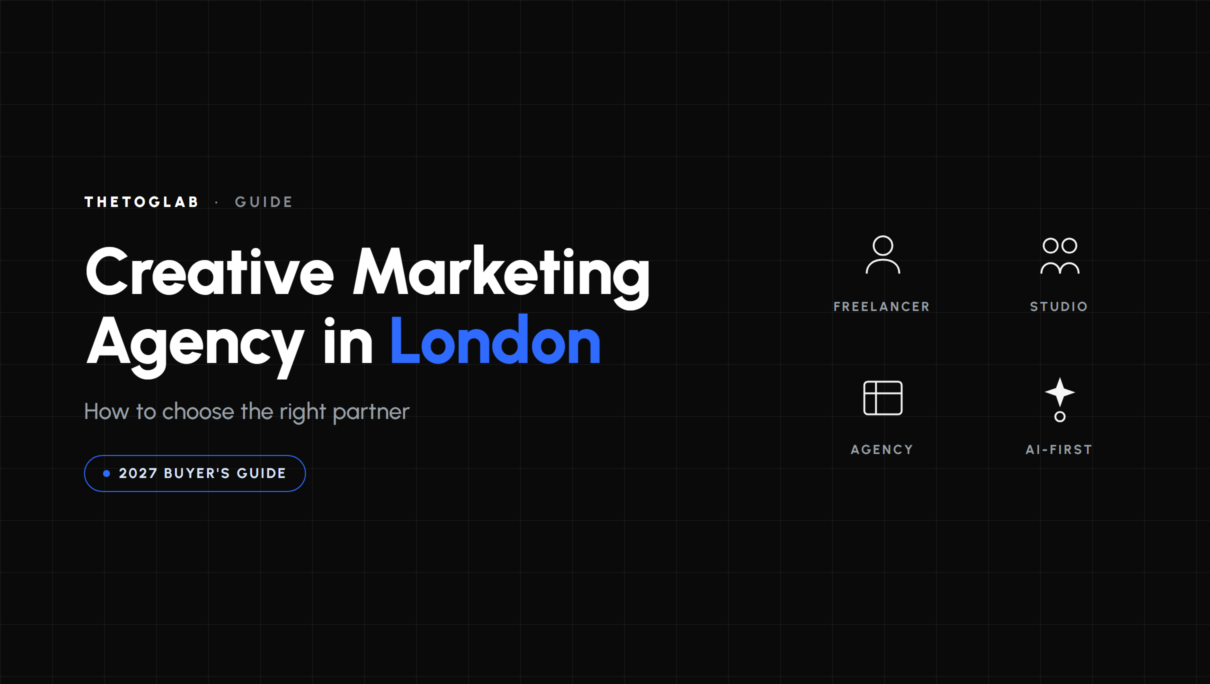
“Creative marketing agency” is a catch-all that hides four very different things you could hand your money to:
- A freelancer. One person, one skill. Cheap and fast, and only as reliable as their week.
- A studio. A small senior team, often founder-led, that owns brand, web and content end to end.
- A full-service agency. Twenty-plus people, account managers, retainers, and the overheads that come with all of it.
- An AI-first studio. A studio that builds AI into the workflow so a small team produces agency-scale output.
Pick the wrong category and no amount of vetting saves you. A seed-stage fintech doesn’t need a network agency’s six-month discovery phase. A national rebrand shouldn’t rest on one freelancer’s annual leave. Get the category right, then judge the shortlist inside it.
| Option | Best for | Typical London cost | Watch out for |
|---|---|---|---|
| Freelancer | One-off assets, tight budgets | £40–£90/hr | Capacity, consistency, no strategy |
| Studio | Brand + web + content as one | £2k–£15k/project | Smaller bench; check who’s actually doing it |
| Full agency | Big budgets, many stakeholders | £25k–£150k+ | Overheads, slow cycles, junior delivery |
| AI-first studio | Speed + scale on a lean budget | £800–£5k/mo | Ask to see the actual AI workflow, not buzzwords |
Ranges are London market figures for context, not quotes. Every brief is different.
The five things that actually predict good work
1. Relevant proof, not a pretty portfolio
A gorgeous portfolio tells you they can make something look good. Relevant proof tells you they understand your problem. When we pitch a fintech, we point at the work we did for Sadapay, because the brief there was trust, compliance-aware language, and a brand that holds up next to people’s money. When it’s hospitality, we point at Soho Garden Dubai or the DOPE café identity. Ask any agency for the closest thing they’ve done to your situation. If they reach for a different industry every time, that’s your answer.
The portfolio proves they have taste. The case study proves they understand you. Hire on the second one.
2. A named human who does the work
The oldest trick in agency-land is the senior pitch and the junior delivery. You meet the impressive founder, then your project quietly moves to whoever’s free that week. Ask one blunt question: “Who, by name, is doing the design and the writing, and will I talk to them directly?” In a studio the answer is usually the person in the room. That matters more than headcount.
3. A real reason they’re faster
Speed is the quiet differentiator in 2027, and “we’re agile” is not a reason. It’s a word. AI is a reason. We use it to turn a week of social production into a day, to draft and iterate copy at pace, and to keep a brand consistent across hundreds of assets. That’s how one studio keeps up with an agency three times its size. The test: ask how they’re fast. If the answer is a vague nod to “AI tools,” push harder. If they can show you the workflow, the tools, the guardrails, the human checkpoints, believe them.
Quick test: ask a prospective agency to walk you through how a single social post gets made, start to finish. The ones using AI well can describe the pipeline in specifics. The ones bluffing change the subject.
4. Pricing you can actually see
Most London agencies hide their prices behind “let’s jump on a call.” We don’t, and I’d be wary of anyone who does. Our packages are public, so you can sanity-check fit before you ever speak to me:
You don’t have to use ours. But you should be able to get a straight number from anyone you’re considering, early, without three meetings first.
5. They ask better questions than you do
On a first call, a weak agency talks about itself. A good one asks about your customer, your margins, what’s actually broken. If you leave that call having explained your own business more clearly to yourself, that’s a strong signal. Strategy is mostly good questions asked in the right order.
Want a second opinion on your shortlist?
Send me the two or three agencies you’re weighing up. I’ll tell you what I’d ask each of them. No pitch, no catch.
The red flags that should end the conversation
Most bad hires send signals early. These are the ones I’d walk away from:
- “We work with everyone.” A studio that’s equally at home with a law firm, a vape brand and a children’s charity is usually equally average at all three. Specialism beats generalism.
- Pricing that needs three calls to surface. If the number is a secret, the number is the negotiation. Walk.
- AI on the homepage, nowhere in the workflow. Plenty of agencies bolted “AI-powered” onto their site and changed nothing. Ask to see it working.
- No clear owner. If you can’t get a straight answer on who does the work, you’ve found the junior-delivery trap.
- All adjectives, no artefacts. “Stunning, bespoke, results-driven,” with no actual examples or numbers behind it.
The questions to ask before you sign
- Who, specifically, will do the work, and can I speak to them?
- Show me your closest project to mine. What was the result?
- How exactly do you use AI, and where does a human still decide?
- What does this cost, and what changes the number?
- What do you need from me to do your best work?
- What happens if I’m not happy with the first round?
When an AI-first studio beats a big agency (and when it doesn’t)
Be honest with yourself about scale. If you’re a founder or a lean in-house team who needs a credible brand, a site that converts, and a content engine that doesn’t stall, a small AI-first studio will almost always give you more output per pound and a faster turnaround. We were built for exactly that gap.
If you’re a large organisation with many stakeholders, procurement, and a need for big-team accountability, a full agency’s structure earns its cost, and you should pay it gladly. The mistake isn’t choosing an agency. The mistake is paying agency overheads for studio-sized work, or handing a make-or-break rebrand to a freelancer with no bench behind them.
Match the partner to the stage you’re at, not the logo on the case study.
If you want to see what “AI-first” looks like in practice rather than in a sales deck, read how we used Claude and Veo3 to 4x a venue’s social output in our Outfields case study: the actual workflow, the actual numbers.
Not sure which way to go?
Book a free 30-minute consultation with me. I’ll look at your brand and site and tell you honestly what you need, whether that’s a starter kit, a full rebuild, or an always-on content engine, even if it isn’t us.
Frequently asked questions
How do I choose a creative marketing agency in London?
Decide what you’re buying first (freelancer, studio, full agency, or AI-first studio), then judge the shortlist on five things: relevant proof in your sector, a named person who does the work, a real reason they’re fast, visible pricing, and the quality of the questions they ask you.
How much does a creative agency cost in London?
It spans widely: freelancers run £40–£90 an hour, studios £2k–£15k per project, full agencies £25k–£150k+, and AI-first studios typically work on monthly packages (ours are £800–£4,500 a month). Always get a number early. Anyone who won’t share one is a flag.
Is an AI-first studio as good as a traditional agency?
For most founders and lean teams, it’s better value: you get senior craft plus AI-driven speed and scale, without big-agency overheads. A large organisation with many stakeholders may still want a full agency’s structure. Work quality depends on the humans. AI is the multiplier, not the designer.
What questions should I ask a branding agency before hiring?
Ask who specifically does the work, to see their closest project to yours and its result, how they use AI and where humans decide, what it costs and what moves the price, and what they need from you. The quality of their questions back is itself a signal.
How long does a branding project take?
A focused brand identity typically runs a few weeks. A brand plus website is usually four to eight weeks, depending on scope and how fast you can give feedback. AI-assisted studios compress production, but good strategy still needs thinking time, so be wary of anyone promising a serious brand overnight.
What should a branding package include?
At minimum: a logo and identity system (colour, type), brand guidelines, and assets for where you actually show up (social, web). A fuller engagement adds a website and an ongoing content system. Match the scope to your stage rather than buying everything at once.
Written by Uzair Amjad, founder of THETOGLAB, a London design and marketing studio (MA, Design & Visual Communications, University of Greenwich). We help founders and lean teams build brands and content engines that punch above their size.